Where it started
A real product brief, and a question nobody was asking.
In early 2026 I evaluated a venture building institutional distribution for tokenized assets in Europe. The brief was serious, and its open questions leaned more toward the architecture constraints, like which providers, how the data pipeline holds up, etc. The regulatory posture was the one much of the space operates on: no custody, no issuance. The goal was that no MiCA license should be required.
And while I could have accepted the architecture as-is and started stress-testing it, I started looking at its edges instead. What about the regulatory assumption, does it hold? MiCA’s custody service covers control over the means of access and not just safekeeping. Reception and transmission of orders covers a hosted interface that takes an allocation instruction and routes it. Transfer services cover moving assets between addresses on a client’s behalf. A platform that hosts the rails, custody integration, stablecoin on-ramping, order flow, will walk into several of those definitions at once. And even if I’m told “we never hold the assets”, operating the rails still makes you an accountable party.
While the venture went another way, the analysis stayed with me and this prototype is what it looks like applied.
The gap
Tokenized funds found institutions. They have not found Europe’s advisors.
Years ago, when BlackRock and Franklin Templeton issued tokenized money-market funds, that was the frontier. But now, it’s become a bit less exotic and the discussion is settled. What we can witness now is quite interesting, the infrastructure that grew around them speaks to two audiences: crypto-native users and large institutions. But in between still sits most of Europe’s advised wealth, like the independent advisors and small wealth-management or family-run firms allocating for retail clients, and unfortunately no rail speaks to them.
The routes that exist do not fit the advisory channel because crypto-native platforms carry a compliance posture that no advisor (CIF in French) can defend to a regulator. Specialized firms want €25k minimum tickets and institutional rails do not onboard three-person practices. My intuition was that the problem was largely unsolved, I framed that as the foundation for Socle. So I got curious and started interviewing financial advisors and this made the demand more concrete. Turns out, five to ten percent of the advisors’ clients were already asking on their own, about half of that was real demand, and they had no route they could stand behind. The demand sits with the people whose job is to allocate carefully and the infrastructure speaks to everyone but them.
The design
Self-hosted, so accountability stays where the accounts are.
The gateway is designed to be deployed by the advisory firm itself, running entirely on the firm’s own accounts. So it will require from the firm the know-how and the operational setup to bootstrap and maintain its own Fireblocks workspace for custody and Circle account (while this isn’t for the platform to solve, the operationalization and training could well be a professional service). The software orchestrates but never stands in between the client and the assets. Whoever runs the instance already holds the regulatory relationships, and the operator of the software never becomes a party to custody, order flow, or settlement. Likewise, the same perimeter is what gives shape to the product surface. The CIF advises and execution runs on the firm’s own rails so the advisory perimeter and the execution perimeter stay structurally separate rather than contractually blurred.
What was built
A settlement engine with an audit trail, wired to real rails.
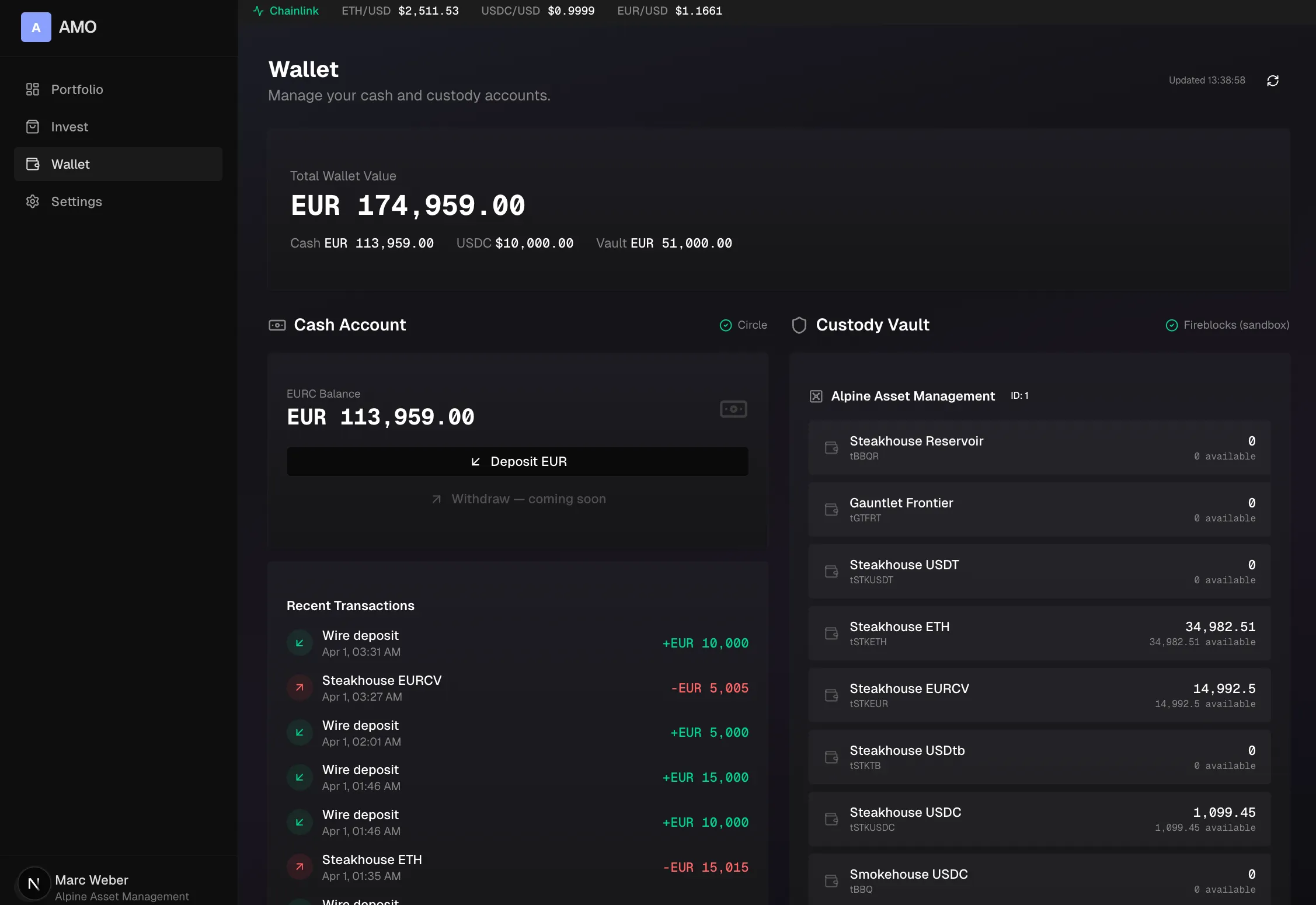
The prototype implements the core allocation loop across five asset classes. It integrates four institutional vendors behind a uniform adapter layer: Chainlink for price feeds, Fireblocks for custody, Morpho for live vault yields and Circle for fiat on-ramps and EURC settlement. Each adapter degrades gracefully when unconfigured so an instance runs with whatever accounts its operator connects.
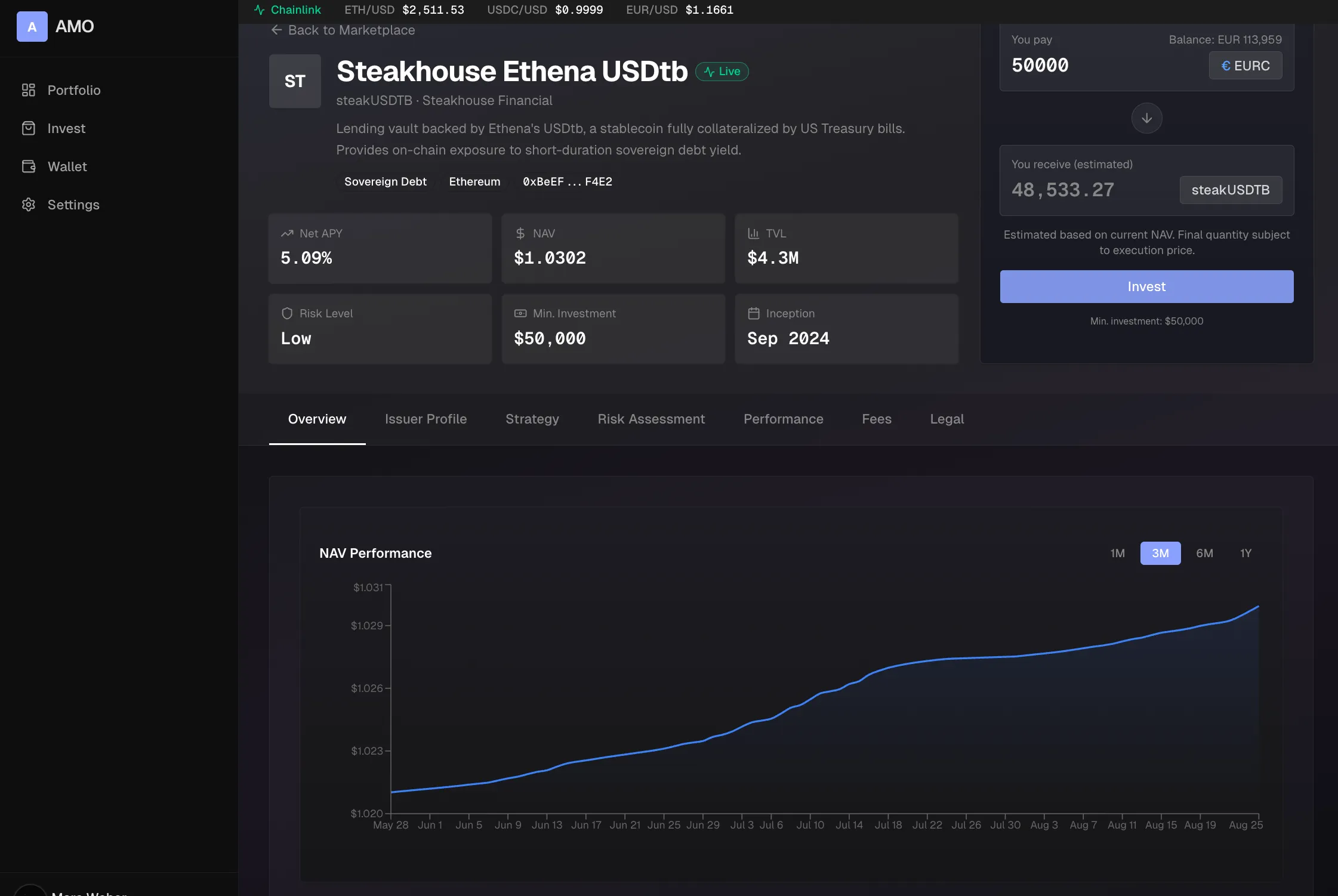
Settlement supports two modes. Mode A is off-chain ledger accounting, positions tracked in application state, with queueing, and this is mostly to account for off-line operations, loss of service, etc. Mode B is on-chain settlement, real ERC-20 token minting to Fireblocks vault addresses on Sepolia testnet, with test tokens mirroring live Morpho vaults. Every order follows an eight-state lifecycle from DRAFT through RECONCILED and quote freshness is enforced at 30 seconds. Settlement validates real Circle EURC balance against debit amount plus fees, and the system fails explicitly with a detailed audit trail when balances are insufficient. No silent failures.
What this validates
That the compliant architecture and the working flow are the same system.
- That a single product surface can orchestrate Chainlink, Fireblocks, Morpho, and Circle into one allocation flow while keeping the CIF/CASP boundary structural
- That the settlement lifecycle can be an auditable state machine rather than ad-hoc API calls
- That on-chain settlement and off-chain ledger accounting can coexist in the same product
- That the self-hosted, own-accounts architecture costs nothing in workflow: the flow the advisor runs is the same one a hosted platform would offer
Limits
What stands between this prototype and production.
The prototype runs against sandbox environments end to end: Circle in sandbox mode, custody and minting on Sepolia testnet. Moving to production rails is configuration more than engineering, but it has not been exercised.
The full design is specified beyond what is implemented. Credentials are supplied at deployment through environment configuration; the design calls for per-firm onboarding of custody and payment accounts through the product itself, and that layer is not built. Multi-tenancy is likewise designed but the prototype is single-tenant. The page describes the design; the prototype implements its core loop.
Finally, the glaring point is really market validation. Users tend to favor a hosted system because it absolves them from the operational and accountability constraints an on-premise solution entails. So while self-hosted can be seen as a design strength, it is also exactly what many firms would rather pay someone else to carry.
The gateway is one half of a pair. Socle is the regulatory back office of the advisor; the gateway is how that same advisor’s clients reach tokenized assets. Same workflow, seen from both ends.