Real-World Assets on Chain: A Market Thesis
July 2026. Data snapshots as of July 2026 unless otherwise noted.
How to read this document. This is an independent market analysis of the tokenized real-world asset (RWA) market. It is not affiliated with, commissioned by, or advocating for any specific protocol, product, or company. The analysis identifies structural requirements that the market must satisfy to scale and evaluates current approaches against those requirements without prescribing a winner. My background includes work in blockchain product strategy, tokenization, compliance and core protocols, which informs the analysis but does not determine its conclusions. All factual claims are sourced and all forward-looking claims are explicitly flagged as assumptions.
Introduction
The first time I started working on Real World Assets was on a New Balance authenticity project back in 2019. At this point there were a lot of discussions and hopes that blockchain would help solve the supply-chain authenticity problem. I stayed close to the space as it shifted, and by 2023, when I was focusing on regulated value transfer protocols at IOG, the discussions had evolved much closer to money markets and cross-border settlement, but it still sounded like another crypto-native promise looking for institutional demand.
As of early 2026, that is no longer the case. Stablecoins have now become an integral part of the crypto economy’s settlement rails. Tokenized Treasury and money-market products have graduated from experiments to usable cash-management instruments. BlackRock’s BUIDL, Franklin Templeton’s BENJI, Ondo’s OUSG, and other cash-like products have shown that regulated assets can live on public-rail infrastructure and still fulfil real institutional use cases. At the same time, large banks and market infrastructure providers have built their own controlled environments for tokenized collateral, bonds, repo, fund admin, and cross-border settlement.
That’s the split I am quite invested in. RWA is not one monolithic market moving unidirectionally. One could argue it is two markets developing side by side. One is public, portable, and increasingly composable, while the other is permissioned, controlled, and built around institutional requirements such as confidentiality and compliance.
A naive claim would be that more assets will move on-chain. Maybe. But that doesn’t tell us much. A tokenized Treasury fund, a private credit pool, a fund share, and a warehouse receipt are not the same problem. The hard part is different in each, and so are the infrastructure and requirements each one needs.
As we will analyze later in this thesis, cash-like products are the cleanest case. The underlying is liquid, the legal structure is familiar, and the workflow is not exotic: subscribe, mint, hold, redeem. That is why this part of the market moved first. The more complex categories, however, are slower to emerge for a reason. For instance, credit needs underwriting and servicing. Private funds need transfer controls, reporting, and admin workflows. Physical assets need custody, inspection, insurance, and dispute resolution. None of that gets solved by putting yet another token in front of it.
So the question for me is not whether RWAs matter. It is: which parts of the RWA market are actually ready to scale, which parts are still fragile, and what is needed before more complex and demanding categories of assets can move on-chain in any meaningful way?
The rest follows from there. Part I is the current market: what is working, what is still fragile, and why. Part II is the architecture problem, the trade-off between public composability and institutional control that neither side has cleanly solved yet. Part III is what a credible answer would need to look like.
If this market already makes you grind your teeth, most of Part I you probably already know. The sizing model in 1.7 and Part II are where the arguments really start.
The numbers here are estimates, from public sources and a bottom-up model. I use them to size the opportunity, not to pretend anyone can forecast this market precisely.
Executive summary
RWAs are real now, but that does not make them one market. Stablecoins and cash-like products have found a place on public rails because the constraint load is light enough. At the other end, banks and market-infrastructure players are building serious workflows inside systems like Canton, Kinexys, HSBC Orion, SIX SDX and Citi Token Services. Some of that activity is huge, and some of it is invisible from public dashboards. But it is not all pointing to the same end-state.
Looking at the numbers, there’s a clear split. Distributed RWA products represent the smallest tranche with roughly $37B today, which might feel underwhelming compared to stablecoins (around $297B) and represented assets, reported around $359B. However, they don’t report on the same baseline. I use those figures mostly to express the fork, not necessarily because they measure one addressable market well. I also built a bottom-up model of my own to check those claims and it lands around $1.35T of TAM by 2030, on the conservative end of the forecasts (with a serviceable slice in the hundreds of billions).
Regulation changed the game too, or more so, it defined the game along with the rules. Indeed, the US, Europe and several active sandbox jurisdictions have made it harder to treat compliance as something teams can design around. While there is consensus that this is progress, it also makes the problem more concrete. A tokenized asset can be compliant in one setup but be hard to use the moment it crosses into another.
This is the problem I delve into. Public rails have liquidity, stablecoin depth and composability but compliance and privacy still live around the asset. While curated institutional networks solve more of the operating workflow, they do it by narrowing the perimeter. So both approaches are rational but neither is enough for the more complex assets stuck in the middle. That is, the ones that need control but become more valuable if they can move outside their original perimeter.
As I kept on writing, I noticed my view started to shift too. I started closer to the idea that the missing piece was programmable compliance on confidential-by-default rails. And while I still believe that it matters, it is too chain-centric a mindset. In my (newfound) opinion, the more durable framing is that the asset’s constraints need to travel with it, regardless of the rails. The next venue needs to verify enough about eligibility, disclosure authority, settlement acceptability, etc. without exposing everything (and without pretending accountability moved too).
To conclude, I do not think one architecture wins the whole market. Cash-like assets like BUIDL can keep scaling on public rails while bounded institutional workflows grow within walled gardens, they aren’t mutually exclusive. To me, the real question is whether the middle becomes large and painful enough to force portability. If it does then the builder might matter less than the interface, whether it is an Ethereum L2 like Aztec, a confidential-by-default rail or even a standard surface that sits across both.
If it does not, well… institutional adoption can still look successful. It might just grow as private rooms, not a portable market.
PART I - The RWA Landscape
The RWA landscape
1.1 What RWAs actually are
RWAs are systems that bridge two incompatible worlds:
- The real world: legal rights, identity, custody, enforcement, regulation, privacy expectations, and adversarial behavior.
- The on-chain world: deterministic execution, 24/7 settlement, composable state, global accessibility and transparent auditability.
1.1.1 RWAs coordinate rights and enforcement, not the asset
For me, the token is kind of like an anchor, it is useless scrap metal without the chain and ship attached to it.
More formally, it is a representation of a rights stack whose meaning lives off-chain: the legal wrapper (a fund, SPV, or note program), custody of the underlying assets, the registries and transfer agents that hold the legal record of ownership, the compliance processes, the auditors and administrators who handle reporting, and the courts and enforcement mechanisms behind all of it.
Now, what RWAs actually improve is fairly specific. They make rights programmable, with transfer and redemption constraints automated. For instance, they make traditional T+1/2 settlement more efficient by automating operations. They simultaneously lower the marginal cost of access while extending global reach, subject to compliance. They make holdings composable, usable as collateral and integrated into broader workflows. And they make accounting auditable, with consistent state and reproducible records. In theory at least.
1.1.2 Why “purely on-chain RWAs” is a category error
Because the underlying is off-chain, an RWA is always hybrid. Some trust sits off-chain and cannot be designed away. The crux is to minimize that trust, compartmentalize it, and operationalize it without making the system unusable.
A market distinction follows from this:
- Portable or “distributed” systems let tokens leave a platform and be held or transferred in external wallets, which makes them potentially composable
- Platform-bound or “represented” systems keep an on-chain record but operate as walled gardens and do not let users move the asset outside platform-controlled workflows
RWA.xyz introduced this distributed vs. represented framing to cut through the ambiguity in tokenized assets and notes that its platform tracks hundreds of tokenized assets spanning many use cases. 1
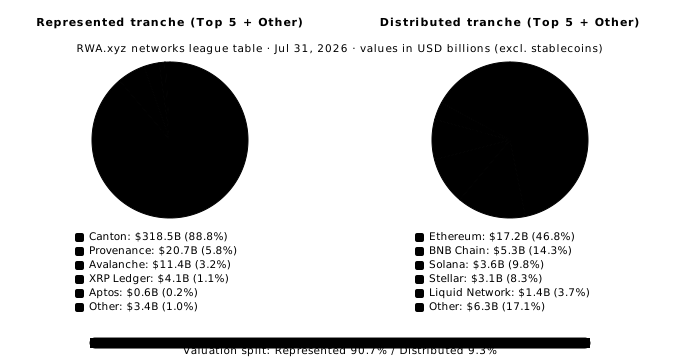
[!WARNING] Measurement caveat: distributed and represented values are not directly comparable Talking to professionals in the space, I often hear that Canton figures are misleading and therefore people tend to make a stronger case for the relevance of the distributed market vs. the represented one. Let me clarify. The distributed tranche (~$37B) consists of independently verifiable on-chain balances, anyone can audit token holdings on Ethereum, Solana, or Stellar. The represented tranche however (~$359B, dominated by Canton at ~$318B) is platform-reported and not independently verifiable by external observers. Canton’s sub-transaction privacy means that the figure likely reflects notional value of assets processed under administration on Canton-based workflows not persistent “locked” value in the pure DeFi sense.
The distinction is still very much analytically useful, it reveals the fork between composable and institutional-controlled rails, but you should understand that the represented number overstates persistent TVL relative to the distributed number. Additionally, significant institutional activity on proprietary bank infrastructure like JPMorgan Kinexys, HSBC Orion, Citi Token Services, SIX SDX, is not captured by any public dashboard. This means that both tranches understate total institutional activity. Section 1.6.3 maps this “dark matter” in detail.
1.2 The institutional baseline: how traditional finance moves capital
In my opinion, to truly understand the value that RWA brings to the table one has to understand the complex layering of actors, integrations, workflows and dependencies of the system it is improving. That is: traditional asset management, which operates through a chain of specialized intermediaries, each maintaining its own records, each adding operational cost and latency.
1.2.1 The capital flow and its actors
A typical institutional investment touches six or more roles before it settles:
| Actor | Function |
|---|---|
| Allocator / Investor | Decides where capital goes and requires transparent and auditable reporting |
| Asset Manager | Deploys capital, manages risk, charges around 0.5–2% AUM |
| Fund Administrator | Maintains the source of truth, the legally meaningful register of ownership |
| Transfer Agent | Processes subscriptions/redemptions, maintains ownership records and enforces transfer restrictions |
| Custodian | Provides legal separation and fiduciary safekeeping of assets |
| Auditor | Verifies the financial state and strict controls. Provides assurance to allocators and regulators |
In addition, in order to support these actors clearing houses match and novate trades, central securities depositories (CSDs) like DTCC, Euroclear, and Clearstream maintain definitive ownership records and correspondent banks handle cash movement.
Each actor maintains its own ledger and reconciliation between these ledgers is a major operational cost and a persistent source of settlement failures.
1.2.2 The value flow today
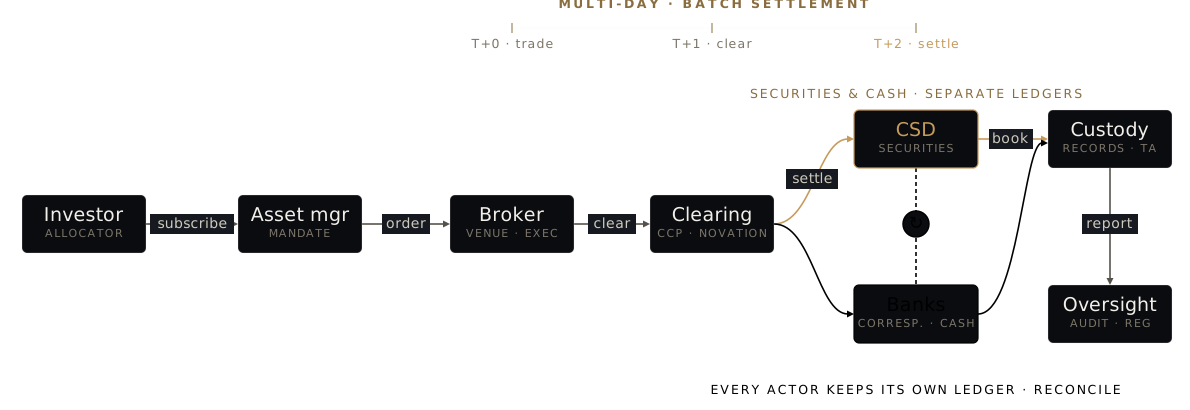
Traditional settlement follows a batch process with significant latency:
- Trade execution: buyer and seller agree on terms (exchange, OTC, or bilateral)
- Clearing: a clearing house (CCP) matches the trade, calculates obligations, and novates the contract, becoming the counterparty to both sides
- Settlement: the CSD moves securities via book entry, correspondent banks move cash via SWIFT messaging and bank rails
- Reconciliation: each intermediary reconciles its records against the others, typically next-day or later
This creates a counterparty risk window: the gap between trade execution and final settlement where either party could default. The industry has compressed this from T+3 to T+2 to T+1 in the US as of May 2024, but the fundamental architecture (multiple ledgers, batch processing, off-ledger cash movement) persists. 2
The cost is structural: failed settlements, manual reconciliation, capital locked as margin against counterparty risk, and operational overhead across every intermediary.
1.3 How RWAs work end-to-end
There isn’t one canonical RWA stack, but most tokenized RWAs follow a recognizable value chain: a legal/operational wrapper off-chain, plus on-chain coordination for issuance, transfer, and redemption.
1.3.1 The actors
For the most part, these are the ones I already presented in 1.2.1. The legal vehicle, the custodian, the administrator and transfer agent, and the auditors and regulators all carry over from the TradFi baseline and do the same jobs. However, there is a handful of roles that change, or appear for the first time once the asset is on-chain.
Compliance stops being a checkpoint and becomes a layer. Instead of having post-trade screenings, eligibility and transfer rules (KYC, KYB, sanctions, holding limits) are encoded and checked at the moment of transfer, at least in the ideal case, with ongoing monitoring and the ability to revoke access. The attestor or oracle operator is genuinely new. As I stated earlier, there is a need to reconcile off-chain/real world state with on-chain truth. Because of this someone has to publish this data in a form others can verify. For instance: the NAV, the reserves, a change in status, etc. There is no clean TradFi equivalent, because in TradFi that state simply lives inside the administrator’s systems and is shared by report. Beyond reputation, this role often requires its own kind of incentivization to ensure current and accurate data. Additionally, the token contract itself becomes a place where rules live, so part of what the transfer agent and the legal documents used to enforce by process is now also enforced in code. And venues change shape: distribution and secondary trading can move on-chain continuously, rather than running only through bilateral or scheduled channels. Liquidity being the main stress point.
The sponsor or issuer sits across all of it, owning product design, distribution, governance, and disclosures.
1.3.2 The value flow
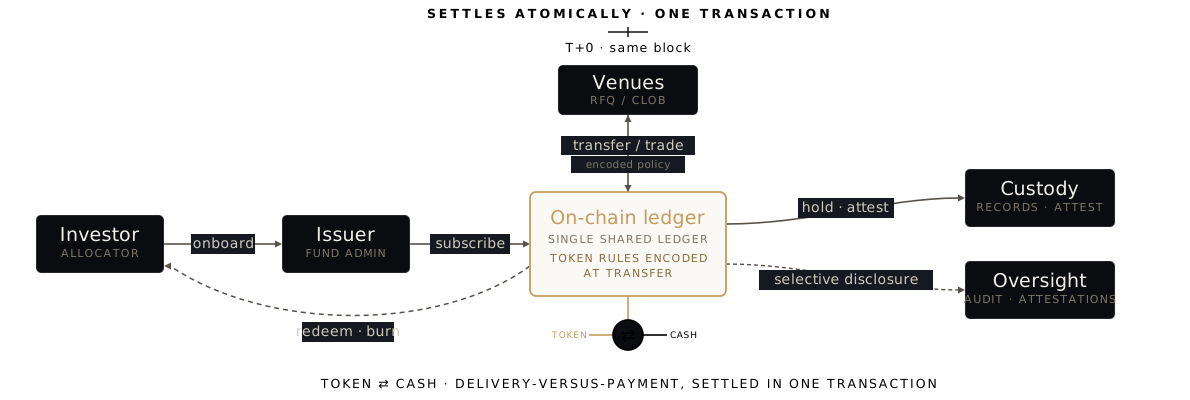
The lifecycle is similar to the TradFi one, so the part worth our attention is where it differs. Onboarding still requires clearing compliance, but this time the proof can be referenced on-chain instead of being re-checked at every step. Subscription and redemption operate in the same way, except (and that’s a major difference) that the token now mints or burns against that movement in one atomic move instead of T+ days apart. However, holding is where there’s a bigger delta. Instead of reconciling separate ledgers against each other after the fact, the NAV, reserves, and status are published as updates anyone can verify. Transfers only go through if the policy encoded in the token smart contract allows it. Finally, oversight will still require operators to implement their standard RBA processes and infrastructure. But now it can also move to selective disclosure rather than full public exposure. For instance, on a privacy-preserving (ZK) chain, an auditor or regulator could be granted a verifiable, scoped view through viewing keys, without the data going public. It’s opt-in by design though. The builder would still need to enable the proper proving circuits and verifying logic within the RWA smart contracts and the participant would have to accept the disclosure terms. In the absence of such a mechanism, and in most cases, oversight is just the off-chain process the issuer already runs.
1.3.3 The capability stack: the 7-layer value chain
In order to bridge TradFi to the tokenized world, we can usually recognize a 7-layer stack:
- Policy and eligibility defines who can hold and transact, it’s typically where most of the KYC/AML infrastructure sits. Part of it is generally encoded at the token level (ERC-3643/Tokeny) and some of it is supported by compliance vendors.
- Issuance and token lifecycle is generally covering mint and redeem functions and roles (which can be encoded within the token smart contracts), but it also requires platforms to surface and deliver those capabilities in a way that’s operationally viable to the issuer (Securitize, Centrifuge)
- Pricing/NAV is delivering truth to the multiple parties that integrate in the system. Oracles such as Chainlink or Pyth deliver on that particular layer.
- Transfer and execution is generally where the asset trades through on-chain venues like DEXs and RFQ platforms, regulated ATSs such as Archax, or OTC. This is also often a bottleneck, especially for post-issuance processes where liquidity is thin for secondary markets.
- Settlement and the cash leg is where value actually moves once a trade happens. For an issuer it is absolutely vital to integrate proper settlement rails to ensure that the RWA value prop is fulfilled: instantaneous atomic settlement. Typically, Circle and other fiat on/off ramp providers play a critical role here.
- Custody, as not all banks have their specialized custody infrastructure for crypto-assets, we’ve seen the emergence of custodians, such as Fireblocks, to provide funds custody with institutional-grade security and integration interfaces
- Reporting and audit: while some of it can be provided through on-chain analytics (e.g. Chainlink), or forensics (Elliptic, Chainalysis, TRM), it remains largely the responsibility of each actor to implement their respective reporting and audit infrastructure to meet their jurisdictional requirements.
The problem is that nobody connects them. No single provider hands the asset manager one workflow across all seven, and that gap, more than any missing technology, is what holds the market back. It’s why even BlackRock’s BUIDL, the most successful tokenized fund so far, had to be hand-assembled: Securitize for tokenization and compliance, Anchorage and Coinbase for custody, Circle for the cash leg, and custom interfaces for reporting, all wired together bespoke. 3 An asset manager without BlackRock’s resources can’t build that from scratch. The seven-layer gap is why adoption stays concentrated at the top, and why the real unlock is orchestration: connecting these layers into repeatable, composable interfaces any issuer can pick up.
1.3.4 From TradFi to RWA: what changes, what doesn’t
Another misconception is that tokenization could eliminate the traditional institutional value chain. This line of thinking applies a DeFi-native mindset to real-world constraints, which is a shortcut I don’t believe in. Tokenization’s aim is to address the existing operational deficiencies while preserving the institutional constraints that exist for legal and fiduciary reasons.
The token changes the operational rails. It does not erase jurisdiction, credit risk, or the fiduciary requirement for qualified custody.
Two practical takeaways fall out of the value chain and ecosystem view:
- Scale comes from standard interfaces, not bespoke integrations. The systems that win make policy enforcement, admin actions, attestations, execution, and settlement repeatable across many issuers and venues.
- Early “RWA progress” is mostly coordination work. The hard part is connecting off-chain truth and constraints to on-chain portability without breaking confidentiality, eligibility, or auditability.
But not all RWAs stress the stack the same way.
1.4 Not all RWAs behave the same: two complementary axes (asset + behavior)
There are two useful ways to look at the RWA market. One is by asset or exposure category, what the underlying is, which is how most people talk about it: treasuries, private credit, real estate, commodities. The other is by behavioral profile, how the product actually operates once it’s live. Asset category is easier to conceptualize, but behavior is what dictates most of the protocol requirements, and two products in the same asset class can end up with very different profiles.
One behavioral dimension is almost a category in its own right: transferability. Whether a token is portable peer-to-peer (“distributed”) or platform-bound (“represented”) 1 is the split that feeds the public-versus-permissioned fork at the center of this thesis. The rest of the profile, lifecycle, pricing, controls, and disclosure, varies enough from one product to the next that it’s easier to read across a table than to describe in the abstract.
| Archetype | Lifecycle | Transferability | Pricing | Controls | Disclosure |
|---|---|---|---|---|---|
| Cash-like fund share (Treasury/MMF) | Subscribe / redeem | Constrained | NAV | High | Selective |
| Private credit note | Servicing / cashflows | Highly constrained | Attested | High | Selective++ |
| Restricted-access equity/fund wrapper | Distribution + restricted secondary | Constrained | Market | Med–High | Selective |
| Allocated commodity receipt | Redemption logistics | Constrained | Attested/spot | Medium | Selective |
| Tokenized real estate claim | Periodic admin actions | Constrained | NAV/appraisal | High | Selective |
| RWA-linked perp / synthetic exposure | Margin / liquidation | Portable | Market/oracle | Medium | Public |
“RWAs” is not one product category. Different archetypes move the bottleneck to different parts of the stack, and which workflow dominates end-to-end is what gives you the three dominant patterns covered next.
1.5 Three patterns: tokenization, origination, and exposure markets
Once you stop treating “RWAs” as a monolithic concept, the next question is what the token is actually doing. I keep coming back to three patterns here, because they split the market more usefully than the asset labels do. Tokenization, origination and exposure markets.
1.5.1 Tokenization (dominant today)
Almost everything live today is most certainly tokenization. Some instrument already exists off-chain, and the issuer tokenizes claims against it, so that it can both tap into more global or composable markets and potentially leverage DeFi instruments not as readily available or operationally viable on traditional rails. You mint, you hold, you redeem, and if the rules allow it you can trade it on secondary markets. In most cases we are looking at TradFi on Web3 rails. One such recent example is Securitize getting listed on NYSE and tokenizing their shares. The signal is obvious, Securitize is arguably bridging web3 and TradFi, and still chose the legal certainty of issuing as a regulated NYSE security when you’d imagine a web3 native company would want to originate directly on chain. The paradigm shift we once expected between TradFi and web3 might not happen. Instead it might just be web3 in the service of TradFi.
1.5.2 Origination (where privacy and verifiability become existential)
Origination is a different animal. The instrument is born on-chain this time or at least its logic is, with the terms, clauses and payment schedule living in the code. Enforcement, though, never leaves the real world.
The real difference is what the chain has to depend on. When you tokenize a fund, someone already underwrote and packaged it off-chain, and the token only needs to expose a NAV and who is allowed to hold it. The complex part stays on TradFi rails. Origination doesn’t get that luxury. Here the loan is the product, and its life keeps going: payments arrive late or not at all, some of it gets recovered, the risk on the book shifts. To price one of these positions, or trade it, or post it as collateral, a counterparty has to see how the loans are actually performing, and that is exactly the data you can’t make public, the borrower financials, the lender’s book, the servicing and default history. So the sensitive material can’t sit safely off-chain the way it does in tokenization. It has to inform the on-chain product for the thing to be worth anything, while a regulator still needs to be able to open it all up when it has cause to.
That is the bind, and it is why origination is the one pattern where confidentiality is not negotiable. Nobody is going to post their financials publicly or broadcast their positions so a smart contract can read them. As we will see in Part II, even though we can observe a clear movement toward confidential and compliance-friendly L1 and L2 solutions, there isn’t at the moment a clear-cut leader or de facto standard that integrates seamlessly with most traditional systems.
1.5.3 Exposure markets (“perpification”)
The third pattern barely tokenizes anything, which is what makes perpification a bit special in our RWA discussion. What perpetuals and other synthetics show you is how a market routes around friction when it really wants to. There is no custody or redemption, all that really matters is a trusted reference price with robust liquidation mechanics.
It delivers the one thing everyone mostly cares about, which is a liquid and always-on market. But this can’t be considered tokenization, even if it can look like that from a distance. Because there’s no claim on the underlying, and if the issuer or the custodian fails, that exposure lands on you. You also lose the real-world rights that were supposed to be the point. And you take on problems you didn’t have before, most of them clustered around the reference price the whole thing leans on. If the market behind that price is thin it can be pushed around, and a regulator somewhere may look at the result and decide it needs a license you don’t have.
The clearest live example is Hyperliquid in 2026. Once its HIP-3 framework let anyone stand up a perp market, a team called trade.xyz launched 24/7 perpetuals on Nvidia, Tesla, Apple and the like, plus a synthetic Nasdaq, and by mid-year those equity perps were trading more than the crypto pairs on the venue with open interest running into ~$3.2B in June (versus ~$790M early 2026). 4 Tokenizing the real thing would have meant dealing with the whole rights stack we mentioned earlier in the tokenization section. But a perp needs a price and a stablecoin to settle in. When the infrastructure is that operationally heavy, synthetics become the default route.
But that liquidity is decentralized mostly in looks. It still runs on a trusted oracle, a single venue, and a stablecoin rail, so the whole thing is propped up by a few centralized points. I come back to that trade-off in Part II.
1.5.4 What changes across the three patterns
So the bottleneck moves, and where it lands is the whole point. For tokenization it’s issuance and redemption, with compliance, custody, and the NAV feed as the things you cannot get wrong. Origination is heavier: underwriting, servicing, collection, the whole apparatus of running a loan book, and that’s where privacy turns existential, because now the sensitive material is the inputs themselves, the borrower data and the models, rather than a balance on a ledger. With exposure markets, custody and redemption drop out and a different anxiety takes over, about whether the index is honest, whether the venue is sound, and how a regulator will end up reading it. The privacy question shifts along the way, from “hide who holds what” to “hide my position, my strategy, and the price at which I get liquidated.”
The reason I keep leaning on this split is that it predicts something useful. Where a pattern’s bottleneck sits tells you, give or take, how long it will take to mature.
Tokenization gets there once the boring parts, issuance and redemption and policy checks and attestations, stop being rebuilt from scratch every time and start being interfaces you can reuse. Origination stays hard for as long as underwriting and servicing and enforcement are bespoke and drenched in sensitive data. But that is also the reason it’s the richest target for protocol-native privacy, because the workaround everyone reaches for instead, bolting access control onto a transparent chain, is both a pain to run and openly hostile to composability. Exposure markets can reach real liquidity before either of the others, and that genuinely matters, but they never hand you an enforceable claim or an issuer you can hold responsible. They work as a way to get liquidity quickly, and as something composable tokenized assets can lean on, but not as a replacement for them.
1.6 Where RWAs are mature vs. fragile
Which parts of the stack are standard enough to scale today, and which are still bespoke and fragile?
1.6.1 Maturity tracks the on-chain/off-chain gap
RWAs mature in proportion to how small the gap is between what happens on-chain and what happens in the real world.
For a tokenized treasury fund, that gap is small. The underlying is standardized and liquid, with a daily NAV and predictable redemption. The token maps to the off-chain product through a simple coordination layer (mint, redeem, policy checks, NAV attestation). It behaves almost like a yield stablecoin, that’s why it was enabled first.
For regulated funds, the gap widens a bit (e.g. a private equity feeder). Transfer restrictions get stricter and more heterogeneous, likewise corporate actions are messy, NAV is periodic, and secondary liquidity is limited as the market is relatively thin.
For credit origination it is wide. Sensitive underwriting inputs, borrower-level performance, enforcement that plays out in physical courts, restructuring. None of that has, at the moment, a clean on-chain form.
For physical goods it is widest of all. Custody means inspection, insurance, logistics, and someone to settle disputes. It is fundamentally non-digital. From my time in trade finance, I saw this up close. Back in 2018, the bank I was at already had an internal innovation unit whose job was to experiment with emerging tech to solve the industry’s oldest problems. For instance AI OCR for paper digitization, blockchain and DLT for cross-border payments, IoT for physical goods tracking and supply chain automation in harbors. Eight years on and the problem space is still open, and that’s before you even get to authenticating the goods themselves.
The wider the gap, the more the whole thing leans on privacy, on the quality of its attestations, and on failing safely, because more sensitive data has to move through the system, more off-chain state has to be injected through oracles, and more can go wrong in ways a smart contract can’t fix on its own.
In order to visualize better this realization, I’ve developed the chart below, where I place the nine RWA.xyz asset classes by operational maturity (low to high) and composability (platform-bound to composable). Figures are the total value shown on RWA.xyz as of Feb 17, 2026. 5 6
%%{init: {"quadrantChart": {"chartWidth": 700, "chartHeight": 700, "pointTextPadding": 10 }}}%%
quadrantChart
    title RWA asset classes by maturity and composability
    x-axis Platform-bound --> Composable
    y-axis Low maturity --> High maturity
    quadrant-1 Composable at scale
    quadrant-2 Institutional rails - mature
    quadrant-3 Bespoke workflows - fragile
    quadrant-4 Composable experiments - early
    Stablecoins - $296.16B: [0.93, 0.97]
    Tokenized Treasuries - $8.84B: [0.80, 0.88]
    Tokenized Commodities - $4.60B: [0.71, 0.80]
    Tokenized Private Credit - $18.54B: [0.27, 0.72]
    Tokenized Non-U.S. Govt Debt - $1.45B: [0.55, 0.66]
    Institutional Alternative Funds - $2.45B: [0.34, 0.60]
    Tokenized Corporate Bonds - $1.74B: [0.43, 0.54]
    Tokenized Stocks - $952.59M: [0.58, 0.32]
    Tokenized Real Estate - $392.52M: [0.25, 0.20]
Two observations this highlights: a category can be operationally mature and still not composable. Private credit is the clearest case, with $18.5B+ active but low composability, because transfer constraints and data sensitivity keep most of it platform-bound. And stablecoins sit up in the corner as the anchor, but they are a settlement rail, not RWA TAM in most sizing.
1.6.2 The categories in the market
At the near end, cash-like instruments. BlackRock’s BUIDL, tokenized by Securitize, reached collateral status at major venues in under a year, even though it took a bespoke assembly of providers that a smaller manager couldn’t replicate. 3 Franklin Templeton’s BENJI runs money-market fund shares one-to-one against tokens on its own recordkeeping stack. 7 8 Ondo’s OUSG wraps short-term treasuries with stablecoin mint and redeem and its own instant-liquidity design. 9 10 (OpenEden’s TBILL is another cash-like example. 11) In every one of them the hard part is operational, making issuance, redemption, and NAV repeatable, not the token standard.
One tier out, regulated funds, where privacy also starts to matter, because a large allocator’s position in a named fund is competitive intelligence. Securitize is the backbone on the infrastructure side. It mostly aggregates and operates issuance, regulated transfer-agent, broker-dealer, and ATS infrastructure through subsidiaries. 12 13 14 In fact, it has since become its own example: its NYSE listing (SECZ) is a tokenized, fully regulated equity (Section 1.5.1). 15 Additionally, Hamilton Lane’s feeder funds and Apollo’s ACRED both use it to put private-market and credit exposure on-chain while keeping the restrictions intact, ACRED even does it across several networks at once. 12 13 On the institutional banking side we got a few good examples too, JPMorgan’s Kinexys runs live intraday repo and tokenized collateral ($7B+/day) while Goldman’s GS DAP issues bonds and structured products on Canton.
Now, credit bears more friction, as it is where the privacy stakes are the highest. The sensitive data impacts more than positions and balances, it also touches the whole underwriting pipeline, the lender’s risk book, servicing performance, and the default record. All of it has to inform the product and none of it can be public. However and most importantly regulators and auditors still need to be able to reconstruct it. That “confidential but accountable” bind is why credit stays fragile even as the largest non-stablecoin category, $18.5B+ active and $33B+ originated, 5 which also makes it the highest-value target for protocol-native privacy. Centrifuge runs permissioned pools for real-world exposures, and Maple built institutional lending primitives like syrupUSDC on overcollateralized loans to institutional borrowers. 16 17 18 19 20 Brazil’s Drex pilot is the sovereign version, wiring the central bank’s digital real to global settlement through Chainlink’s CCIP.
At the far, physical end, the one case that works reasonably well is Paxos gold: each PAXG token is one fine troy ounce of an allocated bar in a vault, with explicit redemption. 21
1.6.3 Institutional tokenization beyond public dashboards
Everything above is drawn from what you can see: RWA.xyz, project docs, on-chain state. But a large and growing layer of institutional tokenization runs on proprietary infrastructure that no public dashboard tracks. This “dark matter” matters because it shows how much conviction is already there, and how firmly institutions are choosing walled gardens over composable rails.
A few of the big ones give the shape of it. JPMorgan’s Kinexys has processed $3T+ cumulatively and moves $7B+ a day on its own chain. 22 HSBC’s Orion has issued $3.5B+ in digitally native bonds, including Hong Kong’s $1.3B green bond, and won the UK’s DIGIT gilt pilot. 23 24 25 Citi’s Token Services runs 24/7 dollar clearing across 250+ banks and 40+ markets. 26 On the public-sector side, Brazil’s Drex and the BIS-led Project Agorá are pushing CBDC-settled tokenization toward real-value testing. 27 28 29 (Goldman’s GS DAP 30, SIX’s SDX 31, and MAS’s Project Guardian 32 round out the same picture.)
Two things follow. Institutional demand is bigger than the dashboards show, so the ~$37B distributed and ~$359B represented figures both undercount. And the fact that these institutions built or joined proprietary rails instead of deploying on public chains is direct evidence that public rails don’t yet meet their bar for confidentiality, control, and compliance. That is the fork Part II is about.
1.7 Market sizing
When I looked through various market reports it became obvious quite quickly that there is no single number, and most of the figures people quote are measuring different dimensions. So I thought it would be worth analyzing it with 3 approaches in mind: what is actually measurable on-chain, what the top-down forecasts claim, and what a bottom-up model of my own has to say.
1.7.1 What’s measured on-chain today
RWA.xyz, one of the most reputable RWA analytics platforms today, splits tokenized value into what they coin portable “distributed” assets, platform-bound “represented” assets, and stablecoins as the settlement rail. As of July 2026 the snapshot was ~$36.8B for distributed, ~$358.7B for represented and ~$296.6B for stablecoins. 5
Now, let’s take a step back. I believe the represented figure needs a heavy caveat. It is platform-reported and dominated by Canton (~$318B). In my opinion, it likely reflects notional value processed or administered rather than value actually locked on-chain the way the distributed figure is (see the Section 1.1.2 caveat). All of it undercounts because the institutional programs on proprietary rails like Kinexys ($3T+ cumulative, $7B+/day), Orion, Citi, SDX, Drex, Agorá, show up on no dashboard at all (see Section 1.6.3). So the real institutional footprint is larger than any single number here would suggest.
1.7.2 What the top-down forecasts say
The headline forecasts all land in the trillions by 2030, but they are scattered because they measure different quantities. McKinsey puts tokenized market cap around $2T by 2030, on a $1T–$4T range. 33 BCG’s “business opportunity” framing gets to ~$16.1T. 34 Standard Chartered stretches to ~$30.1T by 2034 on a demand framing. 35 I interpret this spread as a way to look at the problem through 3 dimensions. Namely market cap versus business opportunity versus share of global assets, over different horizons and asset definitions. The only takeaway worth keeping is the order of magnitude: credibly trillions over the decade, not a number I would plan against.
1.7.3 What a bottom-up model says
When I started to analyze the market in more depth I found it hard to find one consistent figure to work with. The top-down numbers being too wide and heterogeneous to plan against, I decided to build a bottom-up model over a defined asset universe. My strategy is to use an explicit adoption curve per category with a serviceability filter for the part that is actually addressable. Based on a number of public reports (in references), the base universe is in USD trillions: with regulated open-end funds ~78.3, private credit AUM ~2.3, professionally managed real estate ~12.5 and trade finance at ~14. 36 37 38 39
The base scenario:
xychart-beta
    title "TAM / SAM trajectory (Base scenario)"
    x-axis [2026, 2027, 2028, 2029, 2030, 2031, 2032, 2033, 2034]
    y-axis "USD trillions" 0 --> 4
    line "TAM" [0.266, 0.360, 0.545, 0.903, 1.352, 1.801, 2.330, 2.886, 3.601]
    line "SAM" [0.092, 0.124, 0.187, 0.310, 0.464, 0.617, 0.800, 0.989, 1.235]
We can observe that the TAM runs from ~$0.27T in 2026 to ~$3.6T by 2034, while the serviceable slice (SAM) from ~$0.09T to ~$1.2T. These are the outputs of one assumption set over one asset universe, it is NOT the RWA market.
So what can we learn when we compare the model against the other two lenses? Compared to the top-down forecasts it aligns on the conservative end, with the 2030 TAM of ~$1.35T which sits just under the credible market-cap estimates from McKinsey ~$2T 33 and Deutsche Bank ~$1.5–2T 40, but nowhere near the $16T–$30T figures (which measure business opportunity and demand rather than market cap). On the on-chain snapshot, the model’s 2026 starting values (TAM ~$266B, serviceable ~$92B) fall right between the verifiable $37B distributed and the disputed $359B represented. And the whole thing is deliberately conservative, it filters to a serviceable slice and assumes slow adoption for the fragile categories, and still lands at trillions of TAM and hundreds of billions of SAM by 2030. A cautious model that reaches trillions is a stronger claim than an optimistic one that reaches tens of trillions.
1.7.4 The takeaway
The market is large with trillions of TAM over the decade. But the obtainable slice is “only” in the hundreds of billions. The main bottleneck is operations and market structure, not the size of the underlying. The protocols that win are the ones that become usable in the flows already scaling: cash-like instruments, regulated fund distribution, collateral. And the whole path runs into one tradeoff: choose confidentiality and compliance and you give up composability and liquidity, or choose public composability and you bolt on fragile compliance. That specific fork is what I’ll address in Part II.
PART II - The Structural Problem
The structural problem
2.1 The fork: confidentiality vs. composability
Across all three patterns, we usually see teams building RWA systems picking the side of one fork. Permissioned rails make confidentiality and compliance straightforward but give up on liquidity, composability and distribution. Conversely, public rails maximize distribution and integration but compliance is usually an application-level add-on, which in turn hinders liquidity and integration while still leaking positions, balances, strategies, counterparties, etc. As RWAs scale, the ideal solution frames itself: privacy-preserving compliance that still supports selective disclosure, auditability, and integration. As we discussed before, RWAs are not one-size-fits-all instruments. Different workflows and behaviors need different privacy dimensions with different tradeoffs, so the requirement is to make the privacy surface explicit and enforceable, not to hide everything.
Two hypotheses emerge from this:
H1: Institutions want programmable finance but cannot operate at scale if positions, flows and intent are public by default.
H2: Crypto-native markets maximize composability and liquidity on rails where state is broadly visible and integrators can reason about constraints.
The protocol question is whether you can enforce compliance and protect confidentiality without destroying interoperability.
As I’ve shown before, the rise of institutional programs on proprietary rails (Section 1.6.3) makes the case for confidentiality as a hard constraint: Kinexys ($3T+ processed), Canton ($318B represented), HSBC Orion, Citi Token Services. Given a choice, many institutions still picked controlled, confidential systems. But then BUIDL, BENJI and OUSG scaled on transparent rails, so the story is not clean. For the products that have actually worked on public chains so far, confidentiality did not stop adoption. My read is simpler: these were cash-like instruments with little sensitive operating data, and transparent rails were good enough. On the other hand, it is also possible that institutions that favored proprietary rails may have done so for better operational control, vendor relationships, legacy integration or even regulatory comfort as much as for privacy. So Canton’s lead is probably more of a combination of factors rather than the need for privacy alone.
So here are my thoughts:
- Confidentiality is not a binding constraint at scale and the market keeps scaling on transparent rails with application-layer workarounds. Most consistent with what we see today.
- Confidentiality becomes a hard requirement for specific workflows (collateral, credit origination, institutional trading) that haven’t yet scaled on any public rail. This we have not observed, only inferred.
- Finally, the institutions for whom confidentiality matters already moved onto permissioned rails, so what we see on Ethereum is akin to survivorship bias. It is consistent with the data but hard to interpret without evidence from the institutions themselves.
I don’t know which is correct. BUIDL’s success is strong evidence that cash-like instruments don’t need protocol-level privacy. But BUIDL is a treasury fund from the largest asset manager, a government obligation with daily NAV and no sensitive operational data. So there is no definitive case in either direction yet, but the preference is clear. I proceed on the assumption that readings 2 and 3 are at least partly right.
I saw this firsthand when working on Midnight. The signals we received from institutional partners were not about enabling yet another cash-like instrument, but more so about how to integrate their legacy infrastructure to web3 rails. The desired outcome was to enable ZK proofs to work with standard payment workflows like proof of reserves, identity and eligibility checks, inclusion and exclusion lists, etc. From a technology standpoint this led to demands such as RSA support for proof generation and verification (which turns out to be extremely costly). This push for more complex institutional requirements is actually perfectly exemplified with the Monument Bank deal, which was the first UK-regulated bank to tokenize retail deposits, £250M on Midnight.
That is the direction I’m taking. For the workflows the market is actually growing into, credit, collateral, institutional trading, confidentiality and composability and compliance are all required at once, and neither side of the fork delivers the combination. The opening is a rail that stays confidential by default without giving up composability, interoperability, or compliance. And it is scoped on purpose: BUIDL already shows cash-like instruments don’t need it, so the bet is about the next tier up, not the treasuries that dominate the dashboards today.
What would prove me wrong is narrow, it would mean cash-like stays the entire public-rail market and credit and collateral never need composability enough to leave the permissioned world. I don’t think that’s realistic and Part III lays out the full falsification and what the third rail looks like if it does.
Privacy is only one part of the fork. Even when privacy does not matter, RWAs still need controls that public rails do not natively provide. BUIDL proves this: it worked without protocol-level privacy, but only because BlackRock wrapped the token in a bespoke operating stack. An issuer without BlackRock’s resources hits the same gaps. And as products move past cash-like into regulated funds 13 14, collateral 3, and multi-network operations 7 8, the pressure on every one of these dimensions rises.
This is why credit is the hard case. The same loan book has to be private enough for borrowers and lenders, but visible enough for regulators, auditors, investors and secondary buyers.
Each party needs a different view. The regulator needs loan-level reconstruction: who underwrote what, on what basis, and at what loss rates. The investor needs portfolio performance, delinquency, reserves and yield, without individual borrower exposure. The auditor needs to verify underwriting standards without reading every borrower’s tax returns. The secondary buyer needs enough to price the risk without opening a full data room.
If the data is public, the product leaks. If the data sits in a data room, the chain cannot reason about it.
That is where composability breaks. A buyer of a credit position has to leave the chain to price it, a protocol accepting the position as collateral has to trust the originator’s reports, etc. Confidential systems usually handle this by turning every view into a permissioned relationship, which is ok operationally speaking but restricts programmatic integration.
Centrifuge and Maple show the pattern. They can originate real volume, but the asset stops being very composable at the exact point where the credit data starts to matter.
A recent market development actually highlights this gap quite well. Uniswap’s v4 recently enabled pools to attach “hooks,” which is custom logic that runs on swaps and liquidity events so that a pool can gate who trades and enforce eligibility. It’s akin to screening in traditional finance. So a permissioned pool built this way puts compliance on a transparent public rail without standing up a separate chain. But it is still application-layer: the permissioned pool is a walled subset of the AMM, its liquidity doesn’t mix with the open pools, and each issuer’s rules live in its own hook, so the same fragmentation and per-venue compliance come back one layer down. It is a real attempt to solve the confidential vs. composability fork from the public side and which gives us good signals as to where the market is going. 41
The whole problem is deeper than permissioned vs. public. It is about resolving what has to be on-chain for composability and what has to be private for adoption. Any system that forces all data on-chain, or pushes all sensitive data off-chain leaves it unresolved.
2.2 Two poles: Ethereum’s public route and Canton
2.2.1 Why these two poles
The reason I chose to focus on these two specifically is mainly because it would have been too tedious to address the market comprehensively as an inventory. Instead, I focused on the leaders of each tranche, represented vs distributed. The public side is now broader than Ethereum alone, with meaningful activity on BNB Chain, Solana, Stellar, Avalanche, Liquid Network, ZKsync Era, Polygon, Arbitrum, Base and others. But Ethereum is still the cleanest example of the public and composable route, especially around the Ethereum/EVM orbit where stablecoins, custody support and DeFi integrations are deepest. Canton is the opposite pole: represented value clusters there, and the network is built around institutional workflows rather than open composability. 42 43 44
So the comparison should be read as public rails versus Canton, not as a claim that every public RWA lives on Ethereum or even on EVM. Some important public venues do not.
However, two caveats before I start digging in. The figures between the two networks are not measured the same way, and the represented side moves around a lot month to month. A regulated operator layer also sits on top of the public rail, which I come back to in 2.2.3.
2.2.2 The comparison by tension
Looking at the RWA value chain, the friction usually shows up at the edges. The asset can be tokenized, but then it has to connect to cash, compliance, and disclosure. Those are the tight integrations. Cash is needed for subscription, redemption and settlement. Compliance decides who can hold or trade the asset. Confidentiality decides who can see the information around it.
Ethereum was not built with regulated assets in mind. Its public state and open execution make liquidity and integration easy to plug into, but they leave compliance and privacy to the application layer. Canton is the opposite: it is much more contemporary (in the short web3 history) and has an institutional posture by design, with controlled participation and built-in confidentiality, which in turn constrains its ability to support open liquidity and permissionless integration.
The first edge is cash. A tokenized asset needs a way to subscribe, redeem and settle, but the harder question is how easily capital moves beyond the immediate venue. A recent conversation with a crypto compliance infrastructure company made this point more concrete for me. Their core business is in the regulated on/off-ramp and compliance plumbing for businesses. But the problem they kept coming back to was liquidity enablement: better routes between stablecoins and fiat currencies, broader currency coverage, and easier cross-border movement. Compliance gets the user through the gate. Liquidity is what lets the product actually move capital.
That is where public rails have an advantage today. When BlackRock put BUIDL on Ethereum, it did not have to create the surrounding stablecoin and collateral environment from scratch. 3
Canton can support liquidity and settlement inside its governed network. That may be enough when the relevant counterparties are already inside the perimeter. The open question is the boundary. Internal liquidity is not the same thing as open capital mobility.
The second edge is compliance. Ethereum can express rules in smart contracts, but it does not give issuers one shared compliance layer. The rulebook usually has to be built around the asset (KYC/KYB off-chain, identity attestations, allowlists, transfer restrictions, admin roles, venue-specific checks). That is why the market ends up with different implementations. Securitize has its own compliance layer, Tokeny has ERC-3643 and the T-REX stack, while another issuer or venue can build its own variant. All of these can work, but every variant creates a new integration surface. 45 46
As mentioned before, Uniswap v4 hooks are a good step forward in that context, but they only solve a small part of a much more complex problem. A pool can enforce eligibility at the venue level, but the broader compliance problem still goes across identity, issuer policy, transfer rules, reporting, revocation, etc. While hooks move some logic closer to execution, they do not create a shared institutional rulebook. 41
Canton starts from a different place. It was built for institutional workflows and existing financial rails. Daml matters because it is a workflow DSL built around parties, rights, obligations, approvals and disclosure. 47 Compliance is also easier because the network is made of curated actors operating under shared rules, standards and reporting expectations. That reduces openness but it makes the compliance layer more coherent.
The last edge is confidentiality. While Ethereum is public by default, that does not mean it is institutionally auditable in the way regulated finance is. Indeed, a regulator or an auditor would need more than just an address and transaction information, they would also need to know who was controlling the wallet, whether the holder was eligible, the screening status and how exceptions are caught and reported. So public rails still need proper monitoring and attribution infrastructure around them, which is usually what chain analytics and risk management platforms like Chainalysis and Notabene, respectively, provide, for instance.
That is the misconception with transparency. It gives broad visibility, but not the right visibility by itself. It can even create a second problem, because positions, balances, flows and counterparties are visible to everyone, while the information required for regulated oversight still has to be assembled off-chain.
Canton starts from the other side, as it was built with confidentiality in mind. Sub-transaction privacy means that each party sees only what it is authorized to see, and the system is designed around permissioned visibility rather than public exposure. 48 But privacy alone does not explain Canton’s lead. It is one of the reasons the represented market has clustered there, alongside control, legacy integration, vendor fit and regulatory comfort.
This also changes how each rail grows. Ethereum grows when outside apps can attach themselves to the asset. Once a fund token is live, wallets, custodians, lending markets, routers and collateral venues can build around it without waiting for a consortium workflow. That is the advantage BUIDL used when it moved from tokenized fund to collateral asset.
Canton grows differently. It does not need to win users one wallet at a time. When a bank, custodian or market-infrastructure provider joins, it can bring an existing book of clients, counterparties, assets and workflows along with it. Here the distribution happens through institutions instead of developers.
Additionally, Daml also predates Canton. So if an institution already has compatible workflows internally, it is already in good shape for integration. All Canton is asking it to do is coordinate with known counterparties on a model closer to what it already runs. 47 49
Ethereum gives reach first and asks the operator to solve privacy and policy around it. Canton gives control first and gives up portability outside the governed perimeter. This is why the comparison should not be feature-by-feature. Each rail is strong because of the thing the other one doesn’t optimize for.
2.2.3 How regulated assets actually reach public rails today
Concretely, this is currently solved with an off-chain construct that is usually represented by an “operator”. A regulated fund reaches Ethereum today through a company like Securitize acting as transfer agent, broker-dealer, and ATS, wrapping the compliance around an otherwise public token. 13 14 That is how BUIDL, Apollo’s ACRED, and the Hamilton Lane programs got on-chain, and Securitize’s own NYSE listing (SECZ, Section 1.5.1) is the same model turned on itself.
The operator model shows both sides of the public path at once. It expands the reach because once the token exists on Ethereum, it can drop into Aave, Morpho and Maker as collateral without bespoke integration. That is the composability payoff, and it is also why BUIDL became collateral within a year. 3
However, it has limits. The compliance and the sensitive data still live off-chain at the operator level, so the model works well for cash-like instruments but starts to break for anything whose operational data has to travel with it, like credit, for instance. The token can move publicly, but the real asset record is still elsewhere. That is the Section 2.1 problem in concrete form, and the gap that Part III argues protocol-native privacy would close.
2.2.4 The gap neither closes
The gap is composability across real workflows. Cross-border settlement, liquidity corridors, collateral reuse, reporting and servicing all span more than one venue or institutional network. And they need more than a token balance to compose.
So the missing thing is a rail where these use cases can compose without making sensitive data public or trapping it inside one institutional perimeter, rather than simply a more compliant Ethereum or a more open Canton. That is the gap Part III is really about.
2.2.5 Why privacy-first chains have not captured RWAs
So if neither Ethereum’s model nor Canton’s covers the whole stack, then one could safely assume that privacy-first chains like Aztec, Penumbra, Aleo, or Namada should be the obvious answer to the fork. If the public rails leak and permissioned rails wall off, then why not a chain that is private by default and composable?
But that is not where the market has gone. RWA.xyz’s network data shows distributed RWAs clustering on the same established public networks, the ones with liquidity, wallets and stablecoin depth. Represented assets show up elsewhere, especially Canton, while the privacy-first chains do not appear as meaningful RWA venues. 5 42
The reason is that private execution is only one part of the problem. Regulated assets need transactions that are private from the market but reconstructable for the right parties. They also need transfer restrictions, admin actions, NAV and reserve attestations, custody-compatible signing and reporting. Zero-knowledge technology can help with parts of that, but it does not create the operating loop by itself. A privacy chain can hide state and still not be usable for institutional assets. 50 51 52
However, Aztec is the exception worth watching because it is not trying to bootstrap a liquidity graph from zero. As an Ethereum L2, if it can build a standard compliance and disclosure layer that can drive institutional adoption, while inheriting stablecoin depth and the wider Ethereum integration surface, then it will have a clear edge over the competition. So I would not write the category off. But the evidence so far says privacy alone is not enough.
2.3 Liquidity is the constraint
It has been brewing for some time in this thesis, but it should now be clear that liquidity has been sitting underneath the whole argument. The products that moved first were cash-like because the underlying is liquid and the redemption path is simple. Stablecoins keep coming back because they are the cash leg and in that respect, Ethereum’s advantage is that there is already depth around it. Canton shows the opposite trade: institutions can accept less open liquidity when control matters more (another example would be the rise of tokenized deposits). And finally, perps show the extreme case where the market drops the asset entirely just to get liquid exposure.
So before going deeper, it is worth being precise about liquidity as for RWAs, liquidity is multi-faceted.
2.3.1 Liquidity is not one thing
The first kind is primary liquidity where you mint and redeem with the issuer. For most tokenized RWAs today this is the main liquidity mechanism. It is the model behind cash-like instruments such as BUIDL, OUSG and BENJI, where the underlying is familiar, the NAV process is manageable and redemption is the main exit path. 3 9 10 7
That is “real” liquidity, but it is not the same as a secondary market. It depends on a trusted issuer, a working cash leg, a reliable redemption window and an operator that can process the lifecycle. This is why the earliest RWA successes look more like cash-management products rather than open trading venues.
The second kind is bilateral secondary liquidity. This is the RFQ or OTC world: a holder wants to exit before redemption, or the asset does not have continuous redemption so the trade has to be negotiated with an eligible counterparty. The asset has to be transferable under policy, the buyer has to be allowed to hold it and the information needed to price it has to be available without turning the whole thing into a public data room. That is why RFQ is not just an immature version of an order book. For many RWAs, it is the natural first secondary market. Transfer restrictions shrink the eligible buyer set. Fund interests and credit positions require evaluation before pricing. Institutional sizes make public order flow unattractive. And privacy still matters because a position, a quote request or a liquidation point can be valuable information by itself.
The last kind is continuous venue liquidity with order books, AMMs or hybrid markets. To operate, it needs a broad enough eligible holder base, low enough evaluation cost and enough two-sided flow to support persistent price discovery as well and most importantly a well-devised liquidity provider economy. Cash-like products can get close because the asset is standardized and the underlying is liquid. Some tokenized equity wrappers or synthetic exposures can get there because the market already knows how to price the reference asset. But most regulated funds, credit positions and restricted assets stay closer to primary liquidity or RFQ.
So a protocol that assumes every RWA becomes an AMM asset is probably designing for the wrong market. The better question is which type of liquidity the asset can actually support and what has to be true before it can graduate from one type to the next.
2.3.2 Perpification: when the market routes around the asset
Perps are useful here because they show the purest version of liquidity demand. In Section 1.5.3, I described Hyperliquid’s HIP-3 example: trade.xyz launched 24/7 perpetuals on a number of stocks and open interest moved from roughly $790M early in 2026 to about $3.2B by June. 4
My point is not to claim that equity perps are RWAs in the same sense as tokenized fund shares, but more so that it shows what the market does when it wants exposure more than it wants ownership. A perp just needs a price, margin, proper liquidation mechanics and a settlement asset, abstracting the whole operational/compliance stack RWAs require.
This is the useful contrast for actual RWAs. If the market only wants price exposure, synthetics are the shorter route. If the market wants the asset itself, then the trade has to deal with the whole operational and compliance infrastructure that comes with it.
2.3.3 Fragmentation and the case for intents
Back on dealing with actual RWAs rather than synthetic exposure, we know that execution has to route through constraints instead of around them. Typically, the users might be trying to buy an eligible treasury token, redeem into an acceptable stablecoin, move collateral into a venue their custodian supports or rebalance without broadcasting the whole position.
And that is exactly where fragmentation shows up. The user has to navigate across issuers, wrappers, compliance regimes, venues, custodians, settlement assets, chains and jurisdictions. The same economic exposure can be represented through different tokens with different transfer rules. The same investor can be eligible in one jurisdiction and not in another, etc.
This is why intents are a natural interface for RWAs. Not because intents are fashionable, but because the user wants an outcome and the route is constraint-heavy. It could be considered as the technological answer to CASPs’ legal requirements for best-execution, on par and on demand redemption for instance.
An RWA intent has to carry more than price preference. It needs to express eligibility, policy, execution, settlement and disclosure constraints in order to satisfy the requirements of all the actors that are part of that fragmented value chain, while still fulfilling the demand.
2.3.4 The solver bootstrapping problem
This is also why RWA intents are harder than crypto-native intents. A crypto-native solver mostly optimizes price, gas, latency and settlement risk. An RWA solver has to check eligibility, policy, venue rules, disclosure limits and settlement acceptability before price even matters.
The solver set may also be smaller at the beginning. If a venue requires credentials, or if the solver has to interact with a regulated transfer agent, then the earliest solvers will probably look like venue operators, market makers, custodians or regulated platforms rather than anonymous open searchers. That is how the market starts when the flow is thin, high-value and compliance-bound, not a failure of the model.
The bootstrapping path is therefore incremental. Early solvers are likely to be integrated operators with existing compliance infrastructure. As more assets, venues and settlement domains expose constraints in a standard way, routing becomes more competitive. Only later does this start to look like an open solver market.
So intent surfaces should be designed from day one, but the solver ecosystem should not be assumed into existence. It grows when there is enough flow to compete for and enough standardization for that competition to be safe.
2.4 Regulatory clarity and localized stacks
Regulatory uncertainty. For a long time it was what most considered as the major hurdle to RWAs and other crypto use cases development. By mid-2026, this is no longer true. The major jurisdictions are no longer treating tokenized financial assets as an undefined crypto edge case, the US has a crypto-asset taxonomy and a federal stablecoin law, the EU has MiCA, MiFID II boundaries and the DLT Pilot Regime, Singapore, Brazil, the UK and others have sandboxes or live pilots ongoing.
This newfound clarity gives institutions a blueprint to operate within known legal frameworks, but it also points to a more pragmatic observation: tokenized finance will not run through one global rulebook, at least not now. Indeed, most institutions will choose to adapt by localizing the stack (some already have), relying on entities, regulated providers, custody arrangements and settlement assets that fit the jurisdiction they are operating in. It will most likely also weed out smaller or less institutionalized players.
That is the market-structure question for RWAs. If the rules are local then the operating model often becomes local too. The rest of this section looks at what that means for the cash leg, the assets and the networks that try to connect them.
2.4.1 The token does not move the asset out of financial law
The first signal is almost boring, but important. For institutional RWAs, regulators are not creating a new category where tokenized assets float outside the old perimeter, I see it more as an extension of it. The token changes the representation and settlement layer but not the legal nature of the claim.
That is the practical meaning of the US and EU frameworks. In the US, the SEC and CFTC’s interpretive release (33-11412) gives crypto assets a five-category taxonomy. Over the Atlantic, MiCA governs crypto-assets that are not financial instruments, while tokenized securities fall back under MiFID II and the existing securities framework. To top it off, the DLT Pilot Regime then gives regulated market infrastructure a way to test on DLT rails without pretending the asset has left financial law behind. 53 54
That is also why the sandbox layer matters too. Project Guardian, Drex, the UK Digital Securities Sandbox and similar pilots are not evidence of regulatory harmonization. But they show that regulators are willing to let tokenized finance develop inside supervised structures. 32 55 27 28 56
It is apparent that regulatory clarity is beneficial for user adoption. Well-mapped assets don’t get a new rulebook, they inherit the old requirements.
2.4.2 The cash leg becomes jurisdictional
Stablecoins are the settlement rail for public RWAs and both the US and EU have now created frameworks that make regulated stablecoin settlement more usable for institutions. The GENIUS Act creates a US federal framework for payment stablecoins. MiCA creates the EU framework for EMTs and ARTs. And both frameworks make it clear, stablecoins are being normalized as supervised settlement instruments. 57 54
But still, the frameworks are separate. GENIUS creates a US perimeter around payment stablecoins, including permitted issuers, reserve requirements, BSA/AML obligations and the ability to comply with lawful orders. Its extraterritorial reach matters because stablecoins offered to US persons have to fit the US framework, including foreign issuers that want access to that market. 57
MiCA draws the boundaries differently. EMT and ART issuers have to meet stricter reserve, governance and redemption rules, including bank-deposit requirements that start at 30% and rise to 60% for significant issuers. Circle getting authorized in France, while Tether withdrew EURT from Europe, shows that the EU framework is concrete and enforceable enough for issuers to reorganize around it. 58 59
Stablecoin rails used to be a single parameter type of choice, with liquidity corridors best execution in mind. However now it has turned into a regulatory decision too, first and foremost. A stablecoin that works for one investor base, issuer or venue may not work for another. In many cases, the answer will be local: use the regulated stablecoin, bank money or fiat rail that fits the framework of the transaction.
2.4.3 The asset leg stays local
Same observation on the asset side. While a tokenized fund share can be technically portable it might not be legally portable anymore. The token might move across wallets or chains, but the rights behind it depend on the legal regime behind the asset (remember the rights stack we mentioned earlier in the thesis).
While there is now more regulatory clarity in the US and the EU, it doesn’t make those respective frameworks’ tokenized securities requirements interchangeable. US registration, exemptions, broker-dealer and ATS rules do not map cleanly onto EU MiFID II, prospectus, investment firm and trading venue requirements. For example, a fund interest that can be distributed to one class of US investor is not automatically distributable to an EU investor.
Unfortunately sandboxes do not abstract that problem either. Project Guardian (SG), Drex (BRA) and the UK DSS all point in the same direction, but each is still a local experiment. It’s a useful signal, but the desired outcome still has limited portability.
The asset leg therefore fragments differently from the cash leg. The former, around distribution, investor status, venue access and reporting, while the latter around stablecoin authorization and settlement eligibility. Any cross-jurisdictional RWA system has to account for both.
2.4.4 The hard part is between frameworks
This is where the infrastructure requirement becomes narrower as the hard part comes when a workflow has to connect two frameworks with different requirements.
The bridge can be simple in some cases. Settlement can use a regulated stablecoin, bank money or fiat rail that both sides accept. Custody can sit with a local provider. Distribution can happen through a local entity. But the moment the transaction crosses frameworks, somebody still has to answer the same questions: who is allowed to hold the asset, which settlement asset is acceptable, which disclosures apply, and which venue or intermediary is responsible.
That is the place where credentials, policy proofs, selective disclosure and jurisdiction-specific attestations become useful. They do not remove the regulatory burden. They may reduce the cost of carrying it across relationships, venues and settlement rails.
Without some version of that bridge, the operational answer remains localization. The asset can be tokenized, the cash leg can exist, the venue can be live, and the workflow can still stop at the edge of the framework it was designed for.
2.4.5 Why curated networks remain rational
This also explains why curated networks keep making sense. Canton, Kinexys and private banking networks reduce the coordination problem by narrowing it. Participants are known, workflows are governed, counterparties are pre-cleared and the compliance perimeter is part of the network design. 60 22 26
That is a rational response to local regulation. If an institution cannot verify compliance across open rails, it will prefer a network where those questions are handled through membership, contracts and existing relationships. While slower and less portable, it is operationally safer and more coherent.
The tradeoff is the one we have seen throughout Part II. Curated networks internalize compliance and make institutional workflows easier to run, but they also reduce open liquidity and portability. Public rails have the liquidity graph, but the compliance state is fragmented across issuers, venues, wallets, jurisdictions and service providers.
Clearer rules help RWAs because they let institutions build inside known frameworks. The open question is what happens at the edges of those frameworks. If the answer is always a local entity, a local provider and a local rail, open liquidity remains hard to reach even when the asset itself is onchain.
2.5 Conclusion
Part II started with confidentiality vs composability, but I now think that framing is only the surface. The deeper problem is whether a regulated asset can move without losing the constraints that make it usable from a legal standpoint.
A couple of years ago I kept bringing programmable compliance up with DEXes. Most of them acknowledged the problem, but didn’t see the point of solving it. The rules were not settled yet, so building for them felt optional and avoiding was just much simpler. “We will move our entity to the Caymans”, “We will only allow US residents” or even worse “We will geo-block the app”, these are all real things I’ve heard, and that is what killed the deals. There was no clear game to play yet, so nobody played it.
That has changed, but not in the way people usually mean when they say regulatory clarity. The frameworks from the last section made compliance harder to ignore. You can still choose your jurisdiction, your issuer, your venue, etc., but you cannot pretend the rules are optional anymore. The problem moved. Before, teams did not know what game they were playing. Now they know, but the game is local.
Clarity therefore does not solve composability by itself. An RWA can be compliant in one setup and become unusable the moment the workflow crosses into another.
This is where the compliance problem changes shape. The asset cannot move alone. Some proof of eligibility, disclosure and settlement acceptability has to move with it, otherwise every new venue has to start the checks again from zero.
PART III - Where the Bet Sits
3.1 The bet: constraints have to travel
I am not claiming that privacy is the universal missing feature or that every RWA has to move onto confidential rails, like I would have assumed before. BUIDL, BENJI and OUSG already make that claim too broad. It’s perfectly fine for cash-like instruments to keep scaling on public rails, the constraint load is light enough and the operator stack can absorb most of it.
So my bet is now narrower. I believe the market will keep compounding where constraints are light, but the next valuable tier will depend on making some part of eligibility, disclosure, settlement acceptability and asset state verifiable outside the original venue. It won’t be because the whole asset will become trustless, but more so because the receiving end needs enough evidence to act without rebuilding the relationship from scratch.
3.2 What actually travels
As we’ve established in Part I and II, RWAs have heterogeneous behaviors and legal requirements depending on their nature. So it is only natural that what must travel with them differs depending on the asset too. That is why the answer cannot just be “privacy” or “compliance” in the abstract.
If we look at credit for instance, it’s quite clear that a position cannot be priced from a balance alone. Usually, the information resides in the underwriting, servicing, borrower score, defaults, etc. These parameters are for the most part entirely confidential and relying on public information would be too little to price or finance the asset. Typically in credit, or other products like collateral, restricted fund interests, etc., the operational data is the product.
Traditionally, the data already travels in some form through data rooms, private APIs, legal packs or whatever the parties agree on. That model is complete, verifiable and auditable, because the receiving end is able to inspect the file and keep its own records. But it is heavy, relationship-based and ultimately not really composable. Access, retention, onward disclosure and controls are mostly bound around the relationship or network rather than inside the asset workflow.
So the ideal alternative would be selective portability where what is needed to verify the information moves with the asset, but not the bulk data itself, and not as one file everyone can open. It could be a proof, an integrity hash or a reference to data that stays where it already lives, shielded data where the state is small enough, a scoped disclosure plus a proof that the rest of the condition was checked, etc. The implementation can vary, what matters is that the asset carries the reconstructable audit trail and the authorization rules with it (who can verify, access, under which conditions, what are the retention policies, etc.) and potentially references to where the underlying data actually lives.
So when I say constraints have to travel, I do not mean a generic compliance badge. I mean eligibility, disclosure authority, settlement acceptability, pricing context, asset status, transfer restrictions and audit requirements travelling in a form the next workflow can consume. The asset should not arrive naked with the receiving venue forced to rebuild the whole relationship before it can do anything useful with it.
This doesn’t absolve a venue from running its own KYC/KYB, sanctions screening, etc., either. Accountability is not portable. The value add is on the reconciliation. If eligibility, disclosure, settlement and asset-status claims are verifiable, the next venue can see who checked what, under which policy, when, and whether the claim is still valid. It can run its own required checks, take the action, and append its own proof or record to the trail. If something breaks later, the path back is much cleaner: each actor’s claim, reliance and action are visible to the parties allowed to see them.
Portable constraints do not replace compliance work but they make it easier to verify, reconcile and reuse, without pretending accountability moved with the asset.
3.3 The rail still has to run the workflow
Portable proof is not enough if the rail cannot do anything with it.
This is where a lot of privacy-first thinking tends to thin out. While hiding state or proving a fact is part of an RWA workflow, a regulated asset also needs policy enforcement, admin actions, transfer controls, attestations, custody-compatible signing, reporting and failure modes. If the issuer has to keep all of that off-chain, the rail has not really solved the operating loop from Section 1.3.3. It just became another place where the token sits.
This is why the ecosystem matters much more than the actual technology stack. One may have the best intention and technology but if the value chain is missing critical pieces, then the problem can’t be solved. Whether we are talking about the issuer, transfer agent, custodian, venue, attestor, wallet, regulator or the cash leg, if the rail cannot give these actors a repeatable way to coordinate and an economically viable incentive model, then the proof layer cannot become an operating system.
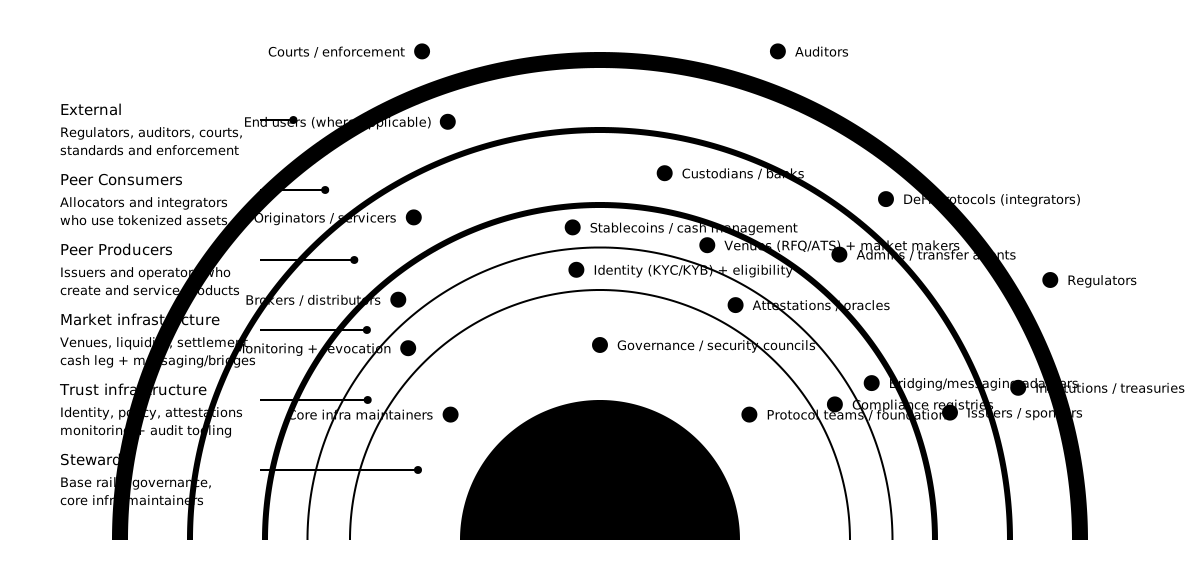
Ideally, a rail would piggyback on the success of EVM-based chains for RWA adoption. The ecosystem was there before RWAs became interesting and it had time to mature organically. Wallets, custodians, stablecoins, token standards, DeFi venues, oracles, etc., already existed. So when a product like BUIDL or OUSG came on-chain, it is not landing in an empty environment. It can plug into distribution and liquidity that already exist.
Canton is a different story, but also a good one. Its ecosystem is not organic in the crypto sense. It is a network of willing and contracted participants who already share the same financial vocabulary (workflows, counterparties, permissions, settlement expectations and reporting duties) and more importantly the same problem. That makes coordination easier when everyone understands the game they are playing.
So the rail problem lies between those two advantages. Public rails have the surrounding ecosystem but the RWA workflow is still bolted around the asset. Canton has workflow coherence, but inside a bounded perimeter. A rail that wants to be relevant in the middle has to do both: inherit or reach existing liquidity, while giving issuers, transfer agents, custodians, venues and attestors a repeatable way to coordinate around the asset.
That graduation path is the setup for the competitive question. Who can support the bounded start without trapping the asset there forever?
3.4 The bet is narrower than the market
It was tempting for me to frame this section as a race, but objectively, the various market approaches are not all trying to win the same market.
As I said before, public rails, with the right operator and app-layer tooling around them can keep winning the light-constraint market. The ecosystem already exists and they already have demonstrated that robust and mature orchestration middleware can be built there. That is the problem BlackRock solved by hand with BUIDL, and the problem smaller issuers cannot keep solving from scratch. 3 But orchestration mostly standardizes the operator workflow. It does not, by itself, make sensitive constraints portable across venues.
Canton and Kinexys can keep winning bounded institutional workflows too. Their perimeter is the product, their strength their relationships. They are useful closed systems for actors who want governed participation, known counterparties and shared operating assumptions. They can remain valuable for a long time without ever solving open composability.
So as stated before, the opportunity lies between those two worlds. This is where credit, collateral, institutional trading, restricted fund use cases live. It’s small in scope but big in value.
In this respect, Aztec is the main actor that could change the game. If an Ethereum L2 can enable privacy, disclosure, policy, etc., into a usable issuer stack while inheriting Ethereum liquidity, then portable constraints may come from the public side and it would make a separate confidential-by-default rail much harder to justify. DAMA 2 is a reason why I am taking that path seriously. Deutsche Bank is choosing a ZKsync-based L2 with ZK privacy for institutional fund tokenization and it shows that privacy-capable Ethereum-adjacent architecture is not a fantasy use case. 61 51
And while confidential-by-default protocols have the cleaner starting point for the portable-constraints problem, they risk being isolated and late to the game. If they cannot reach existing liquidity, custody support and distribution, the architecture could be right and the market would still ignore it.
So I do not think the market converges to one rail. Public rails can keep absorbing the light-constraint market. Curated rails can keep the bounded institutional market. The open question is whether the middle becomes large enough, and painful enough, to reward a rail built around portable constraints. If Aztec gets there first, the thesis is still right. The builder category changes.
3.5 Web3, institutionalized
When I started writing this, I thought the gap was programmable compliance on confidential-by-default rails and I don’t think that was wrong. But it might have been too naive or chain-centric. We don’t need yet another “miracle chain” to support those assets, but a way for its constraints to move with it.
That realization shifted my focus from L1s to the actual plumbing around the rails that institutions might actually use. And I was comforted in that mindspace at Paris Blockchain Week and the other 2026 events around it. The room felt quite different from two or three years ago and while I try to avoid overreading conference crowds (2021 had suits too and most of them evaporated), here the composition had changed. Out of all, there was only one protocol. The rest was payment providers sitting next to wallet teams, on/off-ramp operators, custody stacks, compliance vendors and institutional-solution people. Less speculative, more plumbing.
If the signal is to be relevant, then it mostly proves that the cash, settlement and operator layer is institutionalizing, which is the easier tier. While we are not yet addressing the gap we outlined in this thesis, at least it’s clear TradFi is not adopting web3 as-is. It is shaping the rails around the parts it can use.
That is also my understanding of how TradFi tends to move. It builds or joins systems that map to its own reality and sometimes as a consortium (Canton), sometimes single-handed (Kinexys). And for sure, shared infrastructure can be cheaper than bespoke wiring, but that is not the main point. TradFi builds these systems because it can control the workflow immediately, instead of waiting for public rails to fit institutional constraints.
That is why I struggle to see standalone privacy-first L1s carrying this market on their own. They start too far from the places institutions already have liquidity, custody, distribution and operating habits. To top it off the gravitational pull is still around EVM, whether through L2s or adjacent chains.
So if the gap is not another base layer, then can we safely assume it has to be the interface between controlled issuance and external use?
There are a few ways this can play out. A shared portable-constraints surface gets built, and it pays off. It may come from an Ethereum L2 like Aztec or the market could decide it does not care enough. In which case cash-like assets keep scaling on public rails and bounded workflows stay bounded, while the middle never becomes painful enough to matter.
The outcome I worry about most is the silo version. The market may care about the problem and still solve it in ways that never interoperate. Each institution, operator or network builds something adequate enough for its own perimeter. From the outside, that can look like booming institutional adoption. For this thesis, it is the failure mode wearing a success costume.
So, in conclusion, I do not think one rail resolves the fork. The question is whether constrained assets can become useful outside the relationship that issued them. If not, institutional adoption may still look successful, but it will grow as private rooms, not a portable market.
Footnotes
-
RWA.xyz framework (distributed vs represented definitions): https://rwa.xyz/blog/a-new-framework-for-tokenized-assets-distributed-and-represented ↩ ↩2
-
SEC Final Rule: Shortening the Securities Transaction Settlement Cycle (T+1, effective May 28, 2024). https://www.sec.gov/rules/final/2024/34-99414.pdf ↩
-
Securitize (press release): BlackRock BUIDL surpasses $1B AUM and is accepted as collateral on major crypto venues: https://www.prnewswire.com/news-releases/blackrocks-tokenized-fund-buidl-surpasses-1b-in-aum-is-accepted-as-collateral-on-crypto-com-and-deribit-302381520.html ↩ ↩2 ↩3 ↩4 ↩5 ↩6 ↩7
-
Hyperliquid HIP-3 tokenized-equity perpetuals (builder-deployed perps; trade.xyz 24/7 equity markets; open-interest growth through 2026): https://www.theblock.co/post/408961/tokenized-equity-perps-drive-rwa-trading-boom-to-470-billion-monthly-volume. See also CoinGecko explainer: https://www.coingecko.com/learn/hyperliquid-hip3-hip4-tokenized-stocks-and-prediction-markets ↩ ↩2
-
RWA.xyz dashboard (tokenized asset values snapshot, distributed/represented/stablecoins): https://app.rwa.xyz/ ↩ ↩2 ↩3 ↩4
-
RWA.xyz asset class pages (category totals snapshot): Treasuries https://app.rwa-xyz.com/treasuries, Private Credit https://app.rwa-xyz.com/private-credit, Commodities https://app.rwa-xyz.com/commodities, Institutional Alternative Funds https://app.rwa-xyz.com/institutional-funds, Corporate Bonds https://app.rwa-xyz.com/corporate-bonds, Non-U.S. Govt Debt https://app.rwa-xyz.com/government-bonds, Stocks https://app.rwa-xyz.com/stocks, Real Estate https://app.rwa-xyz.com/real-estate ↩
-
Franklin Templeton (product page): BENJI / FOBXX tokenized money market fund shares: https://www.franklintempleton.com/investments/options/money-market-funds/products/32793/s/benji-investments-franklin-onchain-u-s-government-money-fund/FOBXX ↩ ↩2 ↩3
-
Franklin Templeton (Benji platform overview): https://www.benjiinvestments.com/ ↩ ↩2
-
Ondo Finance (product page): OUSG tokenized exposure to short-term U.S. Treasuries: https://ondo.finance/ousg ↩ ↩2
-
Ondo Finance (blog): OUSG liquidity design: https://blog.ondo.finance/the-ousg-liquidity-advantage/ ↩ ↩2
-
OpenEden (docs): TBILL tokens: https://docs.openeden.com/ ↩
-
Hamilton Lane: tokenized feeder funds and description of Securitize regulatory posture (transfer agent/broker-dealer/ATS via subsidiaries): https://www.hamiltonlane.com/en-us/news/2023/securitize-partner-tokenize-our-funds ↩ ↩2
-
Securitize (press release): Apollo ACRED tokenized fund via Securitize: https://www.prnewswire.com/news-releases/securitize-and-apollo-introduce-apollo-diversified-credit-fund-on-chain-302445486.html ↩ ↩2 ↩3 ↩4
-
Securitize (press release): Hamilton Lane adds five funds to Solana via Securitize: https://www.prnewswire.com/news-releases/hamilton-lane-adds-five-institutional-grade-private-markets-funds-to-solana-via-securitize-302397386.html ↩ ↩2 ↩3
-
Securitize (SECZ) listed on the NYSE and tokenized ~$295M of its own shares on Solana and Avalanche the same day (July 2, 2026); the listing came via SPAC merger with Cantor Equity Partners II: https://www.coindesk.com/business/2026/07/02/securitize-tokenizes-usd295-million-of-its-own-stock-on-solana-and-avalanche-amid-nyse-debut. See also SEC Form 425: https://www.sec.gov/Archives/edgar/data/0001762096/000095010326007552/dp247036_425-securitize.htm ↩
-
Centrifuge (docs): tokenization primitives: https://docs.centrifuge.io/learn/tokenization/ ↩
-
Centrifuge (blog): RWA Launchpad: https://centrifuge.io/blog/onboarding-to-defi-centrifuge-launchpad/ ↩
-
Maple Finance (blog): Maple featured on Spark tokenization “Grand Prix”: https://maple.finance/blog/maple-featured-on-spark-tokenization-grand-prix/ ↩
-
Maple Finance (blog): syrupUSDC launch: https://maple.finance/blog/syrupusdc/ ↩
-
Morpho (docs): syrupUSDC listing: https://docs.morpho.org/rewards/syrupusdc/ ↩
-
Paxos (product page): PAX Gold (PAXG): https://paxos.com/paxgold/ ↩
-
Introducing Kinexys | J.P. Morgan (figures verified May 2026: “$3T+ cumulative transaction volume,” “$7B+ average daily transaction volume”): https://www.jpmorgan.com/kinexys ↩ ↩2
-
HSBC Orion awarded DIGIT platform mandate (February 2026): https://www.hsbc.com/news-and-views/news/media-releases/2026/hsbc-orion-awarded-digit-platform-mandate ↩
-
HSBC Delivers World’s First Multi-Currency Digital Bond Offering ($1.3B HK Govt green bond, 2025): https://www.business.hsbc.com/en-gb/insights/financing/first-multi-currency-digital-bond-offering ↩
-
Disruption Banking: HSBC Goes All-In on Crypto — Record Shares + Tokenized Future (February 2026, “$3.5B+ in digitally native bonds globally”): https://www.disruptionbanking.com/2026/02/26/hsbc-goes-all-in-on-crypto-record-shares-tokenized-future/ ↩
-
Citi Achieves Industry First: Integrating Citi Token Services with 24/7 USD Clearing (September 2025, “250+ banks across 40+ markets”): https://www.citigroup.com/global/news/press-release/2025/citi-integrates-citi-token-services-with-24-7-usd-clearing-real-time-cross-border-payments-liquidity-management ↩ ↩2
-
Chainlink joins Banco Inter, Microsoft and 7COMm consortium for Drex Phase 2 (November 2024): https://www.prnewswire.com/news-releases/chainlink-joins-banco-inter-microsoft-and-7comm-consortium-to-support-trade-finance-use-case-in-phase-2-of-drex-pilot-302309772.html ↩ ↩2
-
CryptoSlate: Brazil advances CBDC technology with new cross-chain pilot using Chainlink’s CCIP (November 2024): https://cryptoslate.com/brazil-advances-cbdc-technology-with-new-cross-chain-pilot-using-chainlinks-ccip/ ↩ ↩2
-
BIS press release: Project Agorá — major central banks and banking sector join forces (April 3, 2024). 7 central banks: BdF, BoJ, BoK, Banxico, SNB, BoE, Fed NY: https://www.bis.org/press/p240403.htm ↩
-
Digital bonds take center stage — EIB €100M bonds on GS DAP and HSBC Orion (November 2024): https://blog.digitalasset.com/blog/digital-bonds-take-center-stage-transactions-tell-the-story ↩
-
World Bank partners with Swiss National Bank and SIX Digital Exchange (May 2024, “over CHF 2 billion worth of securities issued through SDX”): https://www.worldbank.org/en/news/press-release/2024/05/15/world-bank-partners-with-swiss-national-bank-and-six-digital-exchange-to-advance-digitalization-in-capital-markets ↩
-
MAS expands industry collaboration to scale asset tokenisation (2024, 40+ institutions): https://www.mas.gov.sg/news/media-releases/2024/mas-expands-industry-collaboration-to-scale-asset-tokenisation-for-financial-services ↩ ↩2
-
McKinsey (tokenization forecast, tokenized market cap across asset classes, excl. cryptocurrencies & stablecoins): https://www.mckinsey.com/industries/financial-services/our-insights/from-ripples-to-waves-the-transformational-power-of-tokenizing-assets ↩ ↩2
-
BCG/ADDX report (“business opportunity” estimate, different metric than market cap): https://addx.co/files/bcg_ADDX_report_Asset_tokenization_trillion_opportunity_by_2030_de2aaa41a4.pdf ↩
-
Standard Chartered / Synpulse (tokenised assets demand estimate, longer horizon): https://www.sc.com/en/press-release/trade-finance-to-play-substantial-role-in-usd-30-1-trillion-tokenised-real-world-assets-market-by-2034/ ↩
-
ICI Global (worldwide regulated open-end funds assets): https://www.iciglobal.org/statistical-report/ww_q3_25 ↩
-
S&P Global (private credit AUM estimates, citing industry data): https://www.spglobal.com/market-intelligence/en/news-insights/articles/2025/11/private-credit-gains-ground-among-top-private-equity-managers-94290783 ↩
-
MSCI (professionally managed global real estate investment market size): https://www.msci.com/downloads/web/msci-com/research-and-insights/paper/msci-2024-real-estate-market-size/MSCI-2024-Real-Estate-Market-Size.pdf ↩
-
Synpulse paper (trade finance tokenization addressable market, via HKDCA link): https://www.hkdca.com/wp-content/uploads/2024/07/rwa-tokenization-game-changer-global-trade-synpulse.pdf ↩
-
Deutsche Bank Research (tokenized RWAs estimate, excl. stablecoins): https://www.dbresearch.com/PROD/RPS_EN-PROD/PROD0000000000610273/Asset_Tokenization_101%3A_Everything_you_should_know.PDF ↩
-
Uniswap v4 Permissioned Pools documentation: https://developers.uniswap.org/docs/protocols/v4-hooks/permissioned-pools/overview. See also CoinDesk on Uniswap’s permissioned trading pools for tokenized assets: https://www.coindesk.com/business/2026/07/22/uniswap-pushes-deeper-into-tokenized-assets-with-permissioned-trading-pools ↩ ↩2
-
RWA.xyz networks league table: https://app.rwa.xyz/networks ↩ ↩2
-
RWA.xyz network page: Ethereum: https://app.rwa.xyz/network/ethereum ↩
-
RWA.xyz network page: Canton: https://app.rwa.xyz/network/canton ↩
-
Security Token Standard (ERC-1400): https://eips.ethereum.org/EIPS/eip-1400 ↩
-
Permissioned Tokens (ERC-3643): https://eips.ethereum.org/EIPS/eip-3643 ↩
-
Daml documentation: https://docs.daml.com/daml/ ↩ ↩2
-
Digital Asset docs: Canton Protocol: https://docs.digitalasset.com/understanding/canton-protocol/ ↩
-
Canton protocol reference implementation: https://github.com/digital-asset/canton ↩
-
Zcash viewing key documentation: https://zips.z.cash/protocol/protocol.pdf (Section 3.7) ↩
-
Aztec Network developer documentation (2025): https://docs.aztec.network ↩ ↩2
-
Penumbra protocol documentation: https://protocol.penumbra.zone ↩
-
SEC/CFTC Interpretive Release No. 33-11412; 34-105020 (March 23, 2026). “Application of the Federal Securities Laws to Certain Types of Crypto Assets and Certain Transactions Involving Crypto Assets.” Fact sheet: https://www.sec.gov/files/rules/interp/2026/33-11412-fact-sheet.pdf. Full release: https://www.sec.gov/files/rules/interp/2026/33-11412.pdf ↩
-
MiCA — Regulation (EU) 2023/1114 of the European Parliament and of the Council (June 2023). https://eur-lex.europa.eu/legal-content/EN/TXT/HTML/?uri=CELEX:32023R1114 ↩ ↩2
-
Annex A — List of participants in Project Guardian Industry Group (2024): https://www.mas.gov.sg/-/media/mas-media-library/news/media-releases/2024/annex-a—list-of-participants-in-project-guardian-industry-group.pdf ↩
-
UK Digital Securities Sandbox (DSS), joint BoE/FCA, opened September 30, 2024. Policy Statement PS24/12: https://www.fca.org.uk/publications/policy-statements/ps24-12-digital-securities-sandbox-joint-policy-statement-final-guidance. See also A&O Shearman analysis: https://www.aoshearman.com/en/insights/the-uk-digital-securities-sandbox-is-officially-open ↩
-
GENIUS Act. Public Law 119-27, 119th Congress (July 18, 2025). “Guiding and Establishing National Innovation for U.S. Stablecoins Act.” https://www.congress.gov/119/plaws/publ27/PLAW-119publ27.pdf ↩ ↩2
-
Circle MiCA compliance — first global stablecoin issuer, EMI license from ACPR France (July 2024): https://www.circle.com/pressroom/circle-is-first-global-stablecoin-issuer-to-comply-with-mica-eus-landmark-crypto-law ↩
-
Tether discontinues EURT stablecoin citing MiCA regulations (2024-2025): https://www.theblock.co/post/328483/tether-discontinues-eurt ↩
-
Canton Network: Global Synchronizer Foundation membership: https://www.canton.network/canton-network-press-releases/goldman-sachs-hkfmi-and-moodys-ratings-join-the-global-synchronizer-foundation ↩
-
Deutsche Bank DAMA 2 Litepaper — institutional blueprint for asset tokenisation and servicing on Ethereum L2 (June 2025). Uses ZKsync-based L2 with ZK privacy, unveiled under MAS Project Guardian: https://www.db.com/news/detail/20250618-dama-2-litepaper-institutional-blueprint-for-asset-tokenisation-and-servicing-on-ethereum-layer-2. See also Axelar blog: https://www.axelar.network/blog/institutional-privacy-infrastructure ↩